Fables.
Marc Chagall and Carol Wainio
April 30 to September 20, 2026
Curator: Suzanne Pressé
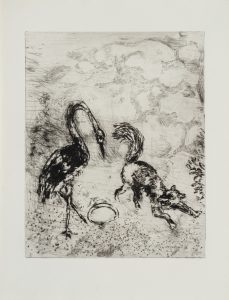
Coming out of the oral tradition, the earliest fables documented to date appeared in the eighth century BC. Following Hesiod and Phaedra, Horace and Aesop, Jean de La Fontaine (France, 1621-1695) consecrated the genre in the seventeenth century. Fables were popularized in an educational setting, showing children human quirks and weaknesses and thereby teaching them the values they should cultivate in order to lead a good life. These stories have lived on across eras and transcended borders, enabling them still today to address contemporary issues. The present exhibition proposes to place side by side the work of two artists, a century apart, who have taken up this ancient body of work: Marc Chagall and Carol Wainio.
Marc Chagall was born in a Jewish community in Belarus in 1887. He became a French citizen in 1937 and died in France in 1985. Considered one of the most important artists of the twentieth century, he is known for his paintings, sculptures, poetry and prints. Chagall was commissioned by the art dealer and publisher Ambroise Vollard to illustrate 100 fables by Jean de La Fontaine. To honour this request, Chagall first painted the works in gouache. Then, from 1927 to 1930, he engraved 100 copper plates, which were printed in 1952. In his prints, Chagall grasped the essence of La Fontaine’s poetry and provided a lively visual illustration of it. Chagall’s compositions are rarely literal or repetitive illustrations of the Fables. Their merit lies in the depth of Chagall’s analysis and his qualities as an illustrator and a storyteller.
Carol Wainio was born in Sarnia, Ontario in 1955, to a family of Finnish immigrants. Fables and tales have been her favourite topic for the past thirty years. By telling stories through painting, she casts a troubled look at the geo-political and environmental contexts in the Anthropocene epoch. In her paintings, as in La Fontaine’s fables, animals are omnipresent and play a preponderant role, a way for her to give them speech. Waino’s paintings are constructed out of accumulations of visual quotations of genre painting, period photographs, illustrations, caricatures, postcards, small figurines, decorative motifs, children’s drawings and a variety of contemporary references. Her works grow out of their association with the different visual representations from a variety of registers. In this sense, her work is dense, with many layers and meanings in which time periods intermingle.
 This exhibition is being circulated by the Musée d’art contemporain de Baie-Sain-Paul. We would like to thank Marc K. Bellemare for the loan of the works included in the exhibition, at the crossroads of literature and the visual arts.